
Pukhraj Stone Price Guide: What Yellow Sapphire Costs, and Why

Last updated 14 September 2026. Every figure here is measured from our own live catalogue on the date shown, not from a rate card.
Two yellow sapphires can weigh the same, come from the same island, carry the same treatment line on the same laboratory's report, and differ in price by a factor of thirty. This guide explains what accounts for that, factor by factor, with the size of each effect measured against our own book of 749 loose gems.
Price in pukhraj is set by six things: colour, whether that colour is natural and whether it will stay, clarity, lustre, cut and proportions, and carat weight. Origin is a seventh thing people talk about, and it is mostly a proxy for the first six.
What is pukhraj stone, and what is it called in English?
Pukhraj in English is yellow sapphire, the yellow variety of corundum. Aluminium oxide, coloured by traces of iron and by colour centres in the crystal. Hardness 9 on the Mohs scale, refractive index 1.762 to 1.770, specific gravity around 4.00. In Vedic astrology it is the gem of Brihaspati, Jupiter, which is why it is also called guru ratna.
One naming problem causes more trouble than the rest. Older Hindi and Urdu glossaries translate topaz as pukhraj, and that error is still propagating through Indian listings today. Yellow topaz is a different mineral, softer, lighter, and worth a small fraction of sapphire. If the report says topaz, you own topaz.
| Language / market | Name |
|---|---|
| Hindi / North Indian trade | Pukhraj, peela pukhraj, pukhraj ratna, pukhraj ratan |
| Sanskrit | Pushkaraj, Pushparaga |
| Tamil | Pushyaragam, kanakapushyaragam |
| Malayalam / Telugu | Pushyaragam |
| Bengali | Pukhraj |
| English / lab reports | Yellow sapphire, fancy sapphire, golden sapphire |
| Astrological | Guru ratna, Brihaspati ratna, the gem of Jupiter |
All the same mineral. The name carries no information about quality.
The six things that set a yellow sapphire's price
Across our live book on 14 September 2026, yellow sapphire ran from ₹1,399 to ₹1,50,376 per carat. That is a 107-fold spread inside one gem type. Here is what accounts for it, with each effect measured while holding the others as steady as the data allows.
| Factor | What it does to price | Measured in our book |
|---|---|---|
| Lustre and transparency | The largest single effect | Up to 4.0× at the same origin, treatment and weight |
| Colour saturation | Large, and the label understates it | 33× spread inside one origin, treatment and weight band |
| Treatment and colour stability | Reprices the gem entirely | Fine untreated Ceylon at roughly 3× fine beryllium-treated Thai |
| Clarity and staining | Steady, well-defined discount | 1.75× between a clean report line and a staining note |
| Cut and proportions | Does not change the rate much; changes what you get for it | 2.05× difference in face-up size at the same weight |
| Carat weight | Multiplies the rate, and the rate falls as size rises | Per-carat median peaks at 3 to 5 ct, then declines |
The colour grade on the certificate, taken on its own, moves the price by about a fifth. Everything else on this list moves it by multiples. That is the single most useful thing in this guide.

Colour: hue, tone, saturation, and how evenly it sits
Colour on a report is recorded as a bucket, not a score. Our catalogue carries the descriptions that come off the certificates, and there are five you will meet.
Light Yellow. Pale, lemony to straw. The largest part of the world's supply and of ours. A light yellow Ceylon gem is a real, natural, unheated sapphire. It simply sits at the bottom of the ladder.
Yellow. Enough saturation that the colour reads as a colour rather than a tint. This is what most buyers mean when they ask for a good pukhraj.
Orangish Yellow. Yellow with an orange secondary. Beautiful in fine material and worth a premium; thin and muddy in commercial heated goods.
Brownish Yellow. Yellow pulled towards brown by iron. Prices up or down depending on whether the brown reads as depth or as dirt.
Vivid Yellow. The most saturated grade. Every gem in our book carrying it is beryllium-treated Thai material, which is dealt with two sections below.
Now the part the certificate will not tell you. Comparing Ceylon, unheated gems of 3 to 5 carats, the median per-carat price of a Light Yellow is ₹10,522 and of a Yellow is ₹12,531. The grade moves the price by about a fifth. But inside a single origin, single treatment and single weight band, per-carat prices in our book run from ₹3,007 to ₹1,00,247 — thirty-three times.
So the label tells you which shelf. Saturation, and how evenly the colour sits across the face of the gem, decides where on the shelf. There is no substitute for looking, which is why we photograph every piece unretouched and would rather you compared two of ours side by side than trusted a word.
Is the colour natural, heated, diffused, irradiated — or only skin deep?
This is the factor that reprices a gem completely, and it is the one where the vocabulary is deliberately murky. Six states, in ascending order of how much was done to the crystal.
Natural, untreated. The report reads no indications of treatment observed, or unheated and untreated. Almost everything in our yellow sapphire book sits here. It is a deliberate buying position: unheated goods hold value better in the Indian trade and the astrological buyer wants them, and it costs more to buy that way.
Heated. High temperature to dissolve silk and lift colour. A heated sapphire is still a natural sapphire, and the word natural describes origin, not condition. Heat is disclosed, permanent, and stable. The small heated group we carry is Ceylon material around one carat in orangish yellow at a median of ₹4,515 per carat, near the bottom of the book, which is a size and quality effect as much as a heat effect.
Beryllium lattice diffusion. Beryllium driven into the crystal at over 1800°C. The colour goes through the stone, so it survives repolishing. Disclosed, priced as fine colour, and dealt with in detail below.
Surface diffusion and coating. Colour that sits in a skin a fraction of a millimetre thick, or in a film on the surface. Repolishing or a chipped facet takes it off. The tell is colour pooling at facet junctions and along the girdle, visible when the gem is immersed in a liquid of similar refractive index. We do not buy or sell surface-diffused or coated gems.
Irradiation. Radiation used to create or deepen yellow. This one matters specifically for pukhraj, because irradiated yellow is the classic unstable colour: it fades. SSEF notes that the unstable colour centres they test for "can occur naturally or result from an (irradiation) treatment". Irradiation is also not always disclosed, and it is not always easy to detect.
Glass filling. Fractures filled with high-refractive-index lead glass so they disappear. The gem looks cleaner and weighs more, and the filler can be dissolved by ordinary jeweller's acid or cracked by a torch during setting. A lead-glass-filled corundum is a composite, not a gem, and it is worth a fraction of what it is usually sold for. We do not buy or sell glass-filled gems.
Those last two positions are policy, not a laboratory certificate. We buy the goods with our own money before you ever see them, and material of that kind does not come onto the board.
Colour that does not stay is not colour you are buying
Some yellow sapphires fade. The colour you see in the shop is not always the colour you own in six months, and this is the risk in this gem that almost nobody discloses at the counter.
GIA reports that "some sapphires, particularly those with a strong yellow component (including padparadscha sapphire), contain unstable color centers that may fade when the stone is exposed to light and/or heat." The colour is being held by a defect in the crystal that ordinary daylight or ordinary warmth can knock out again.
Two cases from GIA's own laboratory. A heat-treated sapphire of about 10 carats arrived with a strong orange hue; after a fade test "the orange color became less pronounced and the stone appeared yellow." An unheated yellow sapphire of about 18 carats, showing "a highly saturated yellow hue", faded to a pale yellow. Both would have been bought on the colour they walked in with.
Two details from that second case are worth holding on to. The colour came back: "once the stone was exposed to sunlight for 30 minutes, the more intense yellow color displayed before the fade test came back." And the trigger was not the light. A follow-up test with light alone left the colour stable, which means the heat from the lamp had done the fading. A gem like that shifts with the seasons, with a hot car dashboard, with a jeweller's steamer, and shifts back again.
GIA's name for the effect is tenebrescence, "or reverse photochromism". Their laboratory returns the gem to a known state by "heating (>150°–300°C) or exposure to intense white LED light with no UV component" and then reports what is left, because "the color after the incandescent light stability test is the color indicated by GIA on colored stone reports for these sapphires." SSEF runs the same discipline: the gem goes "on a metallic reflecting plate and then exposed for several hours (minimum 3 hours) to a strong fibre optic light source (halogen)", the colour is re-read, and where the shift is obvious the report says so and the term padparadscha is withheld.
Note who this affects. Most of the unstable-colour sapphires GIA sees are unheated natural stones, which is to say exactly the gems Indian buyers are told to prefer. And the risk concentrates at the saturated end, because a pale gem has little colour to lose.
What we do about it
Every yellow sapphire goes into sunlight and under halogen before it goes on the board, and we look at it again afterwards. Where the laboratory can confirm, it does. This is internal discipline rather than a document we hand you, and we are not going to dress it up as a certificate.
What stands behind it is that we own the gem before you do. We buy with our own capital, in a trade our family has been in for the better part of three generations, and a gem that fades in stock is our loss, not yours. As far as possible we catch the mischief before it reaches the shelf. If one gets past us, bring it back.
What we will not do is the thing the trade does when a pukhraj goes pale. We will not tell you that your paap came off and that is why the stone lightened. A gem that loses colour lost it to light and heat acting on an unstable colour centre. That is physics, and it is a defect in the gem, not an event in your life.

Beryllium: the most saturated yellow on the market is bought, not found
Every gem in our book graded Vivid Yellow is beryllium-treated Thai material. The most intense yellow we sell is manufactured colour, and we would rather write that sentence ourselves than have you discover it later.
GIA's 2003 study by Emmett and colleagues describes "lattice diffusion of beryllium (Be) at temperatures over 1800°C", by which "a full range of corundum colors, including yellow and blue as well as ruby, have been produced or altered by this treatment." When it first appeared, "initially only orange to orangy pink ('padparadscha'-like) sapphires were seen." Yellow followed.
The gem is still corundum and still, in the everyday sense, a real sapphire. What changed is that a foreign element was driven into the crystal near its melting point to create a colour the crystal did not have. Every major laboratory treats that as a separate and material disclosure.
It is also not easy to catch. GIA notes that "standard gemological testing will identify many of these treated corundums, although in some instances costly chemical analysis by mass spectrometry is required." A loupe and a refractometer cannot rule it out. This is the specific case where a report from a laboratory without trace-element capability is silent rather than reassuring.
The market prices beryllium goods well, and it is worth being precise about how well, because the comparison is usually made against the wrong thing.
We buy only the top grade of this material, and it shows in how tightly it is priced: the beryllium-treated Thai gems in our book run from ₹33,836 to ₹40,603 per carat, a spread of barely 1.2 times across the whole group. Selected goods of one grade price like selected goods of one grade.
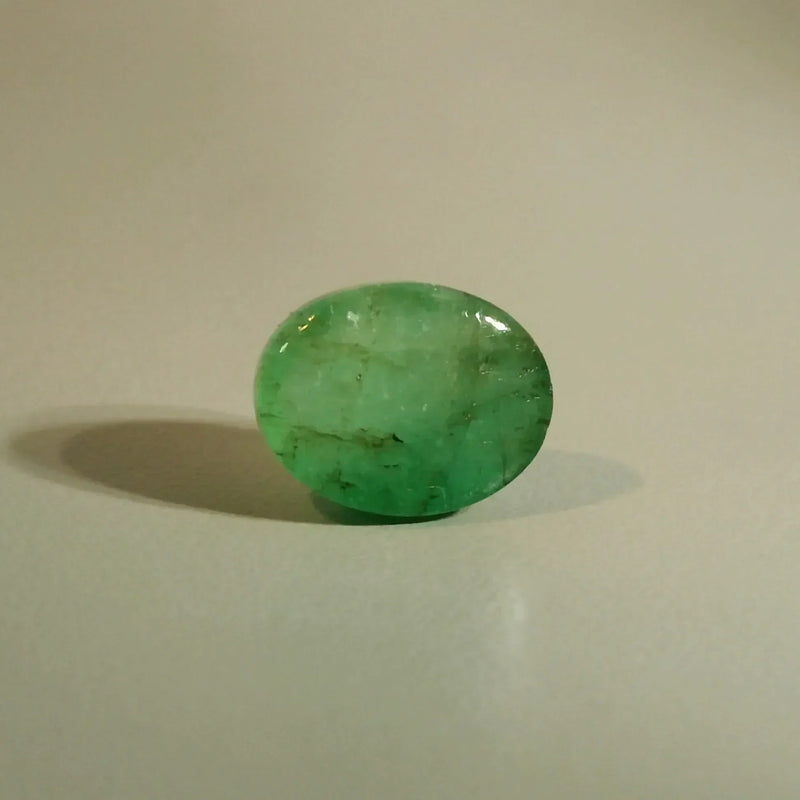
Now set that against the finest untreated Ceylon material in the same book, which is the honest comparison. Our best Ceylon yellows reach ₹1,50,376 per carat. The 10.05-carat Ceylon at the head of this page sits at ₹1,25,313 per carat, at almost exactly the size of the beryllium stones. Fine untreated Ceylon is worth roughly three times fine beryllium-treated Thai.
So the treatment does not buy top of market, and anyone implying it does is selling. What it buys is a strong, even, saturated yellow for a fraction of what that same colour costs when the earth produced it unaided — which is a reasonable thing to want, and the market prices it reasonably once it is on paper. The treated gem is not the problem. The treated gem sold as an untreated one is, and at that point a buyer pays the Ceylon number for the Thai stone.
Bangkok pukhraj and Ceylon pukhraj are trade shorthand you will hear constantly. Bangkok is not a source of sapphire. It is where the world's corundum is treated and traded, and in Indian counter language "Bangkok goods" usually means treated material of unstated origin. That is a description, not an insult, and it belongs on paper.

Clarity: silk, zoning and the staining line nobody reads
Sapphire is not emerald. A fine sapphire is expected to be clean to the eye, and eye-visible inclusions cost money. But the inclusions also do useful work: they are how a gemmologist knows the gem is natural and how the treatment history is read.
What you will see inside a natural pukhraj: fine rutile needles, called silk, which stay sharp and intact in unheated material; colour zoning in straight bands or hexagonal growth patterns; crystals of other minerals; and healed fractures that look like fingerprints. Heating melts or disrupts the silk, which is one of the main ways heat is detected. Curved growth lines and gas bubbles mean synthetic.
Coloured stone reports do not carry a graded clarity scale the way diamond reports do, and ours do not either. What they carry is a description. The one Indian buyers have never had explained to them is staining: a surface-reaching fissure carrying a residue, usually iron oxide picked up in the ground or in cutting, that has coloured the inside of the crack. It is not a treatment. It is a permanent feature that reduces both beauty and durability, because a stained fissure is a fissure, and a fissure can catch on a claw.
The market prices it precisely. In our Ceylon unheated 3 to 6 carat goods, gems with a staining note run a median of ₹6,017 per carat against ₹10,523 where none is noted. A little over two-fifths off, for a word most buyers skip.

Lustre and transparency: the biggest effect in the book
Lustre is how much light the gem gives back. It is the first thing you notice across a counter and the last thing any certificate describes. No laboratory grades it, ours included. The closest measured proxy on our product pages is transparency, recorded as Transparent, Semi-Transparent or Translucent, and it turns out to track price harder than anything else we can measure.
Holding origin and treatment constant, at Ceylon unheated goods:
| Ceylon unheated, 6–10 ct | Median per carat |
|---|---|
| Transparent | ₹12,830 |
| Semi-Transparent | ₹5,516 |
| Translucent | ₹3,209 |
Four times, from the top line to the bottom, on the same island with the same treatment at the same weight. No other factor we can measure moves price that far.
There is a wrinkle, and it is worth understanding rather than hiding. Below about four carats the pattern inverts: among Ceylon unheated gems of 2 to 4 carats, the Semi-Transparent group carries a higher median than the Transparent one, ₹12,682 against ₹6,523. That is not a data error. A deeply saturated sapphire reads as less transparent precisely because the colour is dense, and in small fine goods density of colour is what you are paying for. In larger goods, semi-transparent usually means silky or cloudy, and that is worth less.
So the transparency line on a report means two different things depending on what is causing it. Rich colour, or haze. You cannot tell which from the word, and this is the single best reason to insist on an unretouched photograph or the gem in your hand before you pay.
Cut and proportions: why two 4-carat pukhraj are not the same size
Cut does not change the per-carat rate very much. It changes how much gem you get for the rate, and in the Indian market that effect is large and almost entirely unexamined.
The reason is ratti. Buyers are prescribed a weight, so cutters retain weight, so a great deal of Indian-market sapphire is cut deep — the belly kept thick below the girdle where the buyer cannot see it. You pay for that weight and you do not get to look at it.
Measured across our book, depth as a percentage of width runs from 24% to 100%, with half of everything between 52% and 70%. Face-up area per carat runs from 9.2 to 37.7 mm², with a median of 19.4.
What that means in practice, from two gems in our own stock of almost identical weight:
| Weight | Depth | Face-up area | Per carat | |
|---|---|---|---|---|
| Deep-cut | 4.11 ct | 78% | 64.5 mm² | ₹6,618 |
| Well-spread | 3.97 ct | 24% | 132.3 mm² | ₹14,534 |
The second gem is slightly lighter and shows twice the face-up size. Same ratti count on the invoice, twice the stone on the finger.
The penalty compounds. Taking Ceylon unheated transparent gems of 3 to 6 carats and sorting them by depth, the deepest third gives a median 17.9 mm² of face per carat against 23.0 mm² for the shallowest third, and prices about 14% lower per carat. The deep goods are cheaper per carat and deliver less gem per carat, which is a double discount you should be collecting, not paying.
Neither extreme is the answer. Below roughly 50% depth a sapphire begins to window: light passes straight through the middle instead of bouncing back, and you see a pale washed patch under the table. That 24%-depth gem above is a spread-cut, bought for its face, and it is not what we would put in a ring for someone who wants depth of colour. The sensible band is roughly 55% to 70% depth, which is where about half our book sits.
Ask for the millimetre measurements before you buy, and compare them against the carat weight. Any honest seller has them, because they are printed on the certificate.

Carat weight, and the ratti conversion
Weight multiplies the rate. It does not raise it reliably.
Taking Ceylon unheated goods with no staining note, the median per-carat rate climbs from ₹5,000 below 2 carats to ₹10,525 in the 3 to 4 carat band, holds almost flat through 5 carats, and then falls back to ₹7,019 in the 7 to 11 carat band. Above about five carats the material available at a given quality gets paler, and the rate follows it down.
We use 1 ratti = 0.9 carat, and both figures appear on every product page.
| Ratti | Carats |
|---|---|
| 3 ratti | 2.70 ct |
| 5 ratti | 4.50 ct |
| 5.25 ratti | 4.73 ct |
| 7 ratti | 6.30 ct |
| 9 ratti | 8.10 ct |
| 11 ratti | 9.90 ct |
What a pukhraj actually costs
For the grade most people are buying — Ceylon, unheated, no staining noted, 3 to 6 carats — the middle half of our book on 14 September 2026 sat between ₹6,522 and ₹14,033 per carat, with a median of ₹10,523. Which works out as:
| Size | Lower quartile | Median | Upper quartile |
|---|---|---|---|
| 3 ratti (2.70 ct) | ₹17,600 | ₹28,400 | ₹37,900 |
| 5 ratti (4.50 ct) | ₹29,400 | ₹47,400 | ₹63,100 |
| 7 ratti (6.30 ct) | ₹41,100 | ₹66,300 | ₹88,400 |
| 9 ratti (8.10 ct) | ₹52,800 | ₹85,200 | ₹1,13,700 |
Treat that as the working middle, not the range. Below the lower quartile you are into paler and cloudier material, and the floor of the whole book is ₹1,399 per carat. Above the upper quartile you are paying for saturation and lustre, and the ceiling is a long way up: the finest gems in our book pass ₹1,00,000 per carat and a single piece can cross ₹12,00,000.
Anyone quoting a flat per-ratti rate for pukhraj, with no reference to colour or lustre, is quoting you the price of the paperwork.
Origin: a proxy, not a price
Origin correlates with price in our book, and the usual explanation for why is wrong.
Holding colour and size constant, at unheated gems of 5 to 8 carats in the light yellow and yellow range, the medians run: Ceylon ₹7,519 per carat, Burma ₹3,007, origin not specified ₹2,405. On the face of it origin looks like the driver. It is not.
Look at the spread inside each group. Ceylon material in that same slice runs from ₹1,808 to ₹1,00,252 per carat, a factor of fifty-five. The Burmese goods run a factor of about four and the unspecified goods about three. If origin set the price, Ceylon would be a narrow band sitting above the others. It is not a band at all — it is the whole range.
What is happening is that a country name is not a grade. Every deposit produces its full range. Sri Lanka yields pale commercial goods and world-class stones out of the same ground, and so does every other source. Quality is decided inside the individual crystal — how saturated the colour is, how much light the gem gives back, what the report says was done to it. Origin tells you which geology the material came out of. It does not tell you which end of that geology's range you are holding.
It is also worth knowing what an origin call actually involves, because the word gets used loosely at the counter. Laboratory origin determination is a separate, paid service from a standard identification report, and only a handful of laboratories in the world offer it. It works by comparing a gem's trace-element chemistry, its inclusion suite and its absorption spectra against reference collections of stones of known provenance. It produces an expert opinion, not a certainty, and reputable laboratories say so on the report itself. Two laboratories can reach different conclusions on the same gem. Most certificates sold with gemstones in India carry no origin line at all.
That applies to us as much as to anyone. Our reports certify species, variety, weight and treatment. They do not carry a laboratory origin determination, and we are not going to imply otherwise. Where we state an origin, that is what the material is understood to be; it is not a laboratory saying so. If a seller tells you their Ceylon origin is lab-confirmed, ask to see that line on the report before you pay a premium for it.
Ceylon has earned its reputation honestly. Sri Lankan material is often unheated, often clean, and the geology genuinely produces a particular yellow. None of that makes an individual Ceylon gem good. It raises the odds, which is a statement about a source, not about the gem in front of you.
One last thing on this, because it matters more than the arithmetic. The name on the label is not what makes a gem worth owning. Most people buy one pukhraj in their life. For someone earning ₹25,000 a month, a ₹5,000 gem is a decision made carefully over weeks, and it deserves exactly the same honest description as a ₹5,00,000 one. A clean, stable, well-cut 1.4-carat Ceylon yellow from the bottom of our book is a real sapphire, correctly described, and it will still be that sapphire in thirty years. That is the whole of what anyone can promise you, at any price.
Pukhraj vs sunela, citrine and topaz
Three yellow gems get sold in place of pukhraj. Only one of the three substitutions is honest.
Sunela is citrine, the yellow quartz, and in the Indian astrological tradition it is the recognised upratna for Jupiter. Sold as sunela it is a legitimate gem at a small fraction of sapphire's price. Sold as pukhraj it is fraud, and a refractometer or a set of scales settles it in seconds.
Yellow topaz is aluminium fluorosilicate, hardness 8, lower density, and a different mineral entirely. The pukhraj-means-topaz translation error keeps it in circulation.
Synthetic yellow sapphire is chemically and optically identical to natural and grown in a factory. Cheap, convincing, and the substitution that ordinary observation will not catch. A laboratory catches it easily from growth structures and trace chemistry. Nothing else reliably does.
| Gem | Species | Hardness | Specific gravity | Refractive index |
|---|---|---|---|---|
| Yellow sapphire / pukhraj | Corundum | 9 | ~4.00 | 1.762–1.770 |
| Citrine / sunela | Quartz | 7 | ~2.65 | 1.544–1.553 |
| Yellow topaz | Topaz | 8 | ~3.53 | 1.619–1.627 |
| Synthetic yellow sapphire | Corundum | 9 | ~4.00 | 1.762–1.770 |
Specific gravity is the practical column. A 5-carat citrine occupies about half as much volume again as a 5-carat sapphire, a difference you can see across a counter once you know to look. If someone hands you a large, light, bright yellow gem and calls it a 9-ratti pukhraj at a good price, weigh it and measure it.
What the certificate must say before you pay
Read five lines and ignore the rest of the design.
Species and variety. Should read natural corundum, yellow sapphire. If it says sapphire without natural, ask. If it says topaz or quartz, you are looking at a different gem.
Treatment. No indications of treatment observed or unheated and untreated means untouched. Heated means heated. Beryllium treated or lattice diffusion means diffused. Diffusion alone, coated, fissure filled or glass filled mean the gem is not what most buyers think they are buying. A blank means the laboratory did not test, which is not the same as clear.
Weight and measurements. Both on the paper, both matching the gem. The measurements are how you check the cut.
Comments. This is where staining, filled fissures and colour stability notes live. It is the line buyers skip and the line that moves the price.
Laboratory and report number. Verify it online before you pay. Every serious laboratory has a lookup page. A report you cannot verify is a printed card.
What a certificate cannot tell you is whether the gem is beautiful. Grading language compresses a continuous range into a handful of words, and the whole thirty-three-fold spread discussed in this guide lives inside those words.
How to tell an original pukhraj from a treated or synthetic one
You cannot, reliably, and neither can most jewellers. The folk tests in circulation are worse than useless because they produce confident wrong answers: the white cloth, the coolness to the touch, bubbles in water, scratching glass. Glass scratches under anything harder than about 5.5, which includes citrine, topaz and synthetic sapphire.
What works, in order of what it costs you:
Weigh and measure. Sapphire's specific gravity of about 4.00 is roughly one and a half times citrine's, so a gem too large for its stated weight is not sapphire. This catches substitution, not treatment.
Look under 10x. Natural corundum carries silk, zoning, crystals or fingerprints. Curved growth lines, gas bubbles, or nothing at all inside means a laboratory. Colour pooling along facet junctions means surface diffusion.
Get a report from a laboratory that can run trace-element chemistry, because for beryllium diffusion GIA's own position is that mass spectrometry is sometimes required.
Then ask the seller two questions, because the answers settle it faster than any test. What does the report say about treatment, in the exact words on the paper. And will you take it back if a laboratory of my choosing disagrees.
Wearing pukhraj: the tradition, and what we will not claim
In Vedic astrology pukhraj is the gem of Brihaspati, Jupiter, worn for what that planet is held to govern: knowledge, teaching, counsel, ethics, and expansion generally. The conventional prescriptions are consistent across most schools.
| Question | Conventional answer |
|---|---|
| Which finger | Index finger of the right hand |
| Which metal | Gold, or panchdhatu |
| Which day | Thursday |
| When | Morning, during the shukla paksha |
| Minimum weight | Commonly 3 to 5 ratti; some traditions scale to body weight |
| Recommended for | Sagittarius and Pisces ascendants, and where Jupiter is a functional benefic |
We describe that tradition accurately. We will not tell you it works, we will not tell you what will happen if you wear it, and we will not recommend a weight from your chart, because we are gem dealers and not astrologers. Get that judgement from someone who does it for a living and who is not also selling you the gem. Combining those two roles is the oldest conflict of interest in this trade.
What we will say is narrower. If you have decided to wear a pukhraj, buy a real one, know what has been done to it, and know the colour will still be there in ten years. Those three things are our job and we will answer for them.
What we would buy at each budget
Under ₹10,000. A Ceylon unheated gem of 1 to 2 carats, transparent, with a clean treatment line. Our book runs down to ₹3,550. This is a real, natural, unheated sapphire with paperwork you can verify, and there is nothing apologetic about it. It is the same mineral, the same hardness and the same honest description as anything further up this page.
₹10,000 to ₹25,000. A Ceylon unheated light yellow of 2 to 3 carats, transparent, clean report line. Modest colour, and nobody is selling you a vivid gem at this number.
₹25,000 to ₹75,000. The sweet spot for a first serious pukhraj. Ceylon, unheated, 4 to 6 carats, transparent rather than semi, full yellow rather than pale, no staining note. Spend on lustre and colour before size — you can add size later at the same rate, and you cannot add lustre at all.
₹75,000 to ₹3,00,000. Saturation and clarity together. A well-proportioned Ceylon unheated yellow of 5 to 8 carats, even colour across the face, depth between 55% and 70%, nothing in the comments box. At this level, settle the stability question in writing.
Above ₹3,00,000. Individual gems on their own merits. Nobody should be quoting you a per-carat rate off a table at this level, ourselves included. Come and look at them.
At every level the same sequence. Lustre first. Colour second. Report third. Weight fourth. Origin last, and only as a tiebreak.

Frequently asked questions
What is pukhraj called in English?
Yellow sapphire, the yellow variety of corundum. Some older glossaries translate pukhraj as topaz, which is a different and much less valuable mineral.
What is the price of pukhraj stone per carat in India?
Across our live book on 14 September 2026, yellow sapphire ran from ₹1,399 to ₹1,50,376 per carat. For Ceylon, unheated goods of 3 to 6 carats with no staining noted, the middle half sat between ₹6,522 and ₹14,033 per carat, with a median of ₹10,523.
What is the price of a 5 ratti pukhraj?
Five ratti is 4.50 carats. For that grade, roughly ₹29,400 at the lower quartile, ₹47,400 at the median and ₹63,100 at the upper quartile on 14 September 2026. Pale or cloudy goods sit well below; fine colour well above.
How many carats is 7 ratti pukhraj?
6.30 carats, using 1 ratti = 0.9 carat.
What decides the price of a yellow sapphire?
Six things: colour saturation, whether the colour is natural and stable, clarity, lustre, cut and proportions, and carat weight. In our own book lustre and transparency move price the most — up to four times at the same origin, treatment and weight. The colour grade printed on the certificate, on its own, moves it by about a fifth.
Is beryllium treated yellow sapphire as valuable as untreated?
No, and the gap is larger than most people assume. Comparing the finest of each in our own book, untreated Ceylon yellow reaches ₹1,50,376 per carat while our beryllium-treated Thai goods top out at ₹40,603 — fine untreated material is worth roughly three times fine treated material at the same size. Beryllium buys saturated colour at a fraction of what nature charges for it. It does not buy top of market.
Does yellow sapphire fade?
Some do. GIA has documented sapphires with a strong yellow component containing unstable colour centres that fade under light or heat and recover in sunlight. It affects unheated natural gems as much as treated ones, and irradiated yellow is the classic case. We put every yellow sapphire into sunlight and under halogen before listing it, and the laboratory confirms where it can.
My pukhraj has become lighter. What happened?
The colour was being held by an unstable colour centre and light or heat has knocked it out. It is a property of the crystal. Some stones recover in sunlight and some do not. It is not a sign about you, and any seller who tells you the stone absorbed something on your behalf is explaining away a defect they sold you.
What is beryllium treated yellow sapphire?
A sapphire with beryllium diffused into the crystal at over 1800°C to create or alter colour. It remains corundum, the colour goes through the stone, and it is a material disclosure. GIA notes detection sometimes requires mass spectrometry. Every gem in our book graded Vivid Yellow is beryllium-treated Thai material.
What is the difference between diffusion and coating?
Beryllium lattice diffusion puts colour through the whole stone and survives repolishing. Surface diffusion and coating put colour in a skin or a film, and repolishing or a chipped facet removes it. We do not sell surface-diffused or coated gems.
Do you sell glass-filled sapphire?
No. Lead-glass filling hides fractures and adds weight, and the filler can be dissolved by jeweller's acid or damaged during setting. A glass-filled corundum is a composite rather than a gem.
What does "staining" mean on a yellow sapphire report?
A coloured residue, usually iron oxide, inside a surface-reaching fissure. It is not a treatment. It reduces beauty and durability, and in our book it costs a little over two-fifths of the per-carat price.
Why do two pukhraj of the same ratti look different sizes?
Because of how deep they are cut. Indian buying is by weight, so cutters retain weight below the girdle where you cannot see it. Across our book, face-up area per carat runs from 9.2 to 37.7 mm². Two gems of about four carats in our stock differ by twice in face-up size. Always ask for the millimetre measurements.
Is Ceylon pukhraj better than Bangkok pukhraj?
Bangkok is not an origin — it is where corundum is treated and traded. Ceylon is a real source with a genuinely good average, but the price range inside our own Ceylon material is fifty-five times, so the label says very little about the individual gem.
Is heated yellow sapphire natural?
Yes. Heating is a treatment applied to a natural gem and the result is still natural corundum. What changes is the disclosure. Unheated gems carry a premium in India.
Is sunela the same as pukhraj?
No. Sunela is citrine, a quartz, and the recognised upratna substitute for Jupiter. It costs a small fraction of sapphire. Sunela sold as pukhraj is fraud.
Which finger is yellow sapphire worn on?
Conventionally the index finger of the right hand, in gold or panchdhatu, on a Thursday morning. That is the tradition as practised; we describe it rather than prescribe it.
How do I clean a yellow sapphire?
Warm water, mild soap, soft brush. Sapphire is hardness 9 and chemically stable. Skip the ultrasonic if the report notes fissures or staining, and keep it away from prolonged heat if colour stability has not been settled.
Which yellow sapphire is the best?
The one with the best lustre and the most evenly saturated colour you can afford, with a clean treatment line on a verifiable report and sensible proportions. Not the largest, not the most famous origin, and not the cheapest per ratti.
Sources
- GIA, Yellow Sapphires with Unstable Color, Gems & Gemology, Summer 2022 — gia.edu
- GIA, An Update on Sapphires with Unstable Color — gia.edu
- SSEF, Colour stability of gems — ssef.ch
- Emmett et al., Beryllium Diffusion of Ruby and Sapphire, Gems & Gemology, Summer 2003 — gia.edu
- Precious Carats live catalogue, 749 loose yellow sapphires, 14 September 2026
Related Articles